
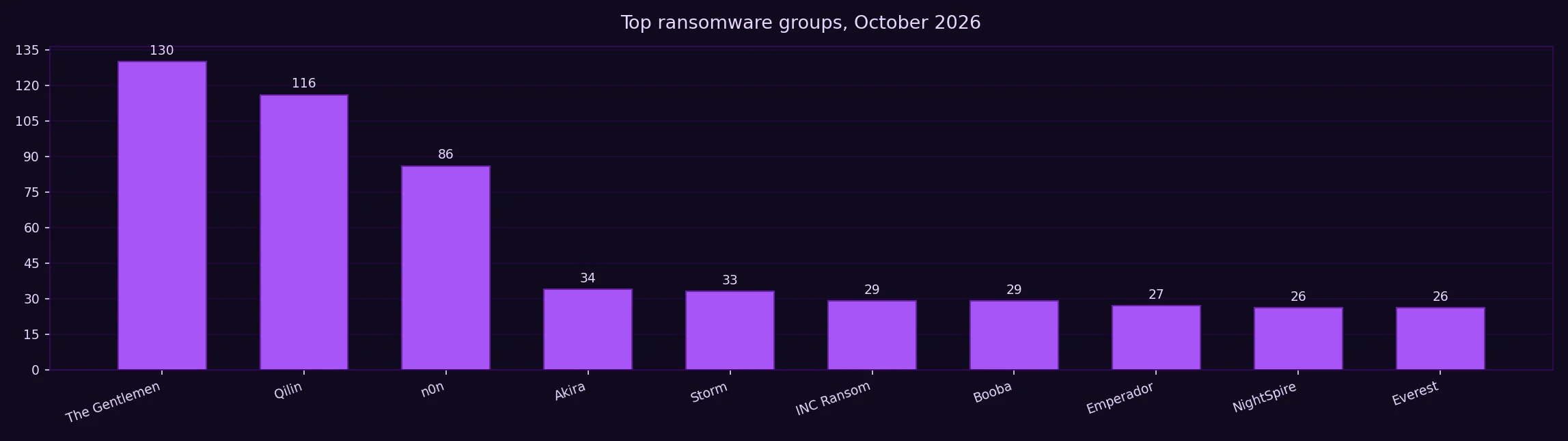
PurpleOps recorded 1060 victims posted on ransomware extortion sites during October 2026. The data reveals high publication volume originating from a single operation, with The Gentlemen: 130 victims.
How many ransomware victims were posted this month?
The collection parameters for this specific report measure the publication volume during the exact reporting window spanning from 2026-10-01 to 2026-10-31. Across the duration of these 31 days, PurpleOps monitored the dedicated leak sites operated by extortion groups and compiled the claimed compromises into a central dataset. During September 2026, threat actors posted a verified total of 892 victims to their respective leak sites. The variance between these consecutive reporting periods determines the percentage increase documented in the title.
Which groups were most active?
PurpleOps identified 85 distinct groups that posted compromised organizations to their dedicated leak sites during the observation period. Qilin generated a high number of publications within this specific operational subset, taking responsibility for 116 victims. Security personnel analyzing the access vectors for this specific group should review the Check Point VPN CVE-2026-50751 (CVSS 9.3) Bypass publication. The extortion operation known as n0n claimed 86 victims on its respective site. Akira maintained a consistent position among the active groups by posting 34 victims. Storm operated its site infrastructure to publish 33 victims.
INC Ransom posted 29 victims, and network defenders investigating these specific intrusions can access the SonicWall CVE-2026-15409 Exploited by Inc Ransomware documentation. Booba recorded an identical publication volume to the previous group, adding 29 victims to the monthly distribution. Emperador followed in the ranking by listing 27 victims. NightSpire claimed 26 victims on its leak site. Everest also posted 26 victims. The remaining operations outside this primary subset claimed a combined total of 524 victims.
Which sectors took the most hits?
The victim dataset categorizes the compromised organizations into 21 classified sectors based on their primary business operations. Manufacturing ranked as the most heavily targeted industry segment within the classification system, with operators publishing 159 victims associated with production and industrial operations. Healthcare facilities and related medical service providers constituted the next largest category in the sector breakdown, recording 116 victims exposed on the leak sites. Construction & Engineering firms appeared frequently on the dedicated leak sites throughout the reporting window, registering 101 victims in the dataset. Technology / Software vendors sustained targeted attacks that resulted in 83 victims appearing in the monthly publication logs. Transportation & Logistics companies accounted for 78 victims among the tracked organizations. The remaining 516 victims were distributed across the other specific classified sectors tracked in the intelligence database. A small subset comprising 7 victims lacked sufficient identifying data and fell into an unclassified sector.
Which countries took the most hits?
The geographic tracking within the dataset spans organizations located across a total of 92 countries. The United States absorbed the highest concentration of localized victims by a substantial margin, with extortion sites posting 471 victims based in the nation. Germany ranked next in the regional distribution by recording 51 victims tied to local infrastructure. Threat actors posted 34 victims operating from Canada during the observation period. Organizations based in India accounted for 29 victims exposed by the extortion groups. Extortion sites listed 28 victims from Spain. The other active operations globally contributed to a combined tally of 447 victims located outside these primary targeted nations.
Security teams require direct access to the raw publication data to monitor the operations of Qilin, INC Ransom, and the other distinct groups tracked in this specific dataset. PurpleOps provides the BUGSY analysis platform and the JINX threat intelligence product to map these metrics. To review the full dataset and integrate the publication feeds into defensive operations, visit Ransomware Tracking Solutions.